

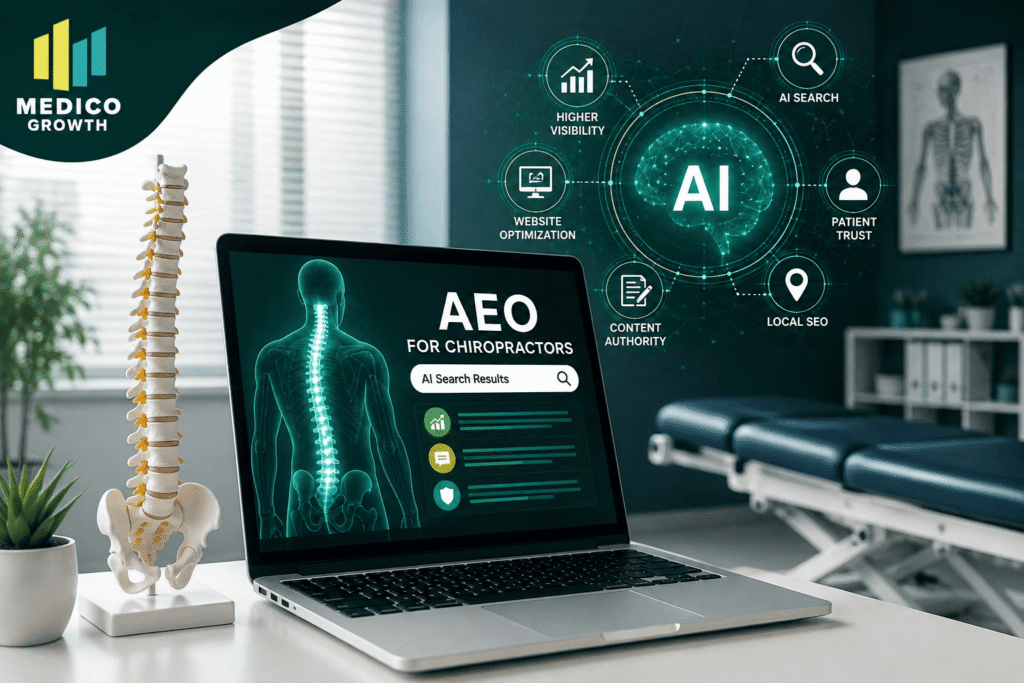
AEO for chiropractors is the process of making chiropractic website content easier for search engines and AI-powered platforms to understand, retrieve, and present when people ask relevant questions.
A potential patient may no longer search only for a phrase such as “chiropractor near me.” They may ask more detailed questions like:
Answer Engine Optimization helps organize your website so these questions are answered clearly, accurately, and in a way that search systems can interpret.
A strong AEO strategy should clarify:
AEO should complement traditional SEO rather than replace it. Technical SEO, local visibility, useful content, internal linking, authority, and user experience still form the foundation.
Search behavior is becoming increasingly conversational.
Someone experiencing back discomfort might first ask an AI-powered search platform:
“Why does my lower back hurt after sitting all day?”
Their next query could be:
“Would a chiropractor be appropriate for this?”
Later, they may search:
“Experienced chiropractor near me.”
This means chiropractic practices should create content for more than transactional keywords. They also need to answer educational, comparison, local, and appointment-related questions.
AI search systems try to interpret context and relationships between topics rather than relying only on exact keyword matches.
For a chiropractic practice, useful entities can include:
When these ideas appear naturally within useful content, search systems receive stronger context about what the website represents.
A successful AEO strategy is not based on repeating the primary keyword throughout every paragraph.
The goal is to create pages that answer questions clearly while demonstrating expertise, topical relevance, local context, and genuine usefulness.
Start with questions patients ask before they contact your clinic.
Your reception team, chiropractors, consultation notes, Google Search Console queries, website search data, and commonly received messages can all reveal useful topics.
Questions may include:
These questions can become blog sections, FAQs, service-page content, or dedicated educational resources.
The strongest content generally addresses questions that genuinely matter to prospective patients rather than creating articles only because a keyword tool shows search volume.
Different queries represent different stages of the patient journey.
Someone searching:
“Why does my neck feel stiff after working at a computer?”
is probably looking for information.
Someone asking:
“What happens during a chiropractic consultation?”
is researching a service.
Someone searching:
“Chiropractor near me open today”
has much stronger local and appointment intent.
Your content strategy should support each stage rather than trying to make every page perform the same job.
Informational articles can answer educational questions, while service pages can explain available care and location pages can help patients evaluate where to visit.
This approach also strengthens your broader chiropractic SEO services strategy by connecting informational search demand with commercial service pages naturally.
Important questions should usually receive a clear answer near the beginning of the relevant section.
For example:
What is AEO for chiropractors?
AEO for chiropractors is the process of improving chiropractic website content so search engines and AI platforms can understand the practice, services, expertise, location, and answers it provides.
After giving the concise answer, expand with context, examples, and practical information.
This format benefits readers who want a quick response while also creating clear information blocks that search systems can interpret.
Useful formatting includes:
Avoid burying the main answer beneath several paragraphs of unnecessary introduction.
Titles and meta descriptions should accurately describe what a page provides.
A strong title for an AEO article should identify the topic immediately rather than relying on vague language.
For example, a title based on:
“AEO for Chiropractors”
provides much stronger topical clarity than something generic such as:
“The Future of Digital Marketing.”
Meta descriptions should reinforce search intent and encourage relevant users to visit the page.
Every important page should have its own title and description rather than duplicating metadata across multiple chiropractic services or locations.
Clear heading structure helps readers scan information and helps search systems understand how topics relate to one another.
Use:
Avoid using heading tags simply because they look visually attractive.
A page discussing chiropractic AEO could move logically from definition to strategy, local search, trust, technical optimization, measurement, and FAQs.
That creates a meaningful subject hierarchy instead of a collection of unrelated keyword sections.
Internal links help users move from educational information to more specific resources.
For example, a section discussing local AI visibility could naturally direct readers to a guide about local SEO for chiropractors.
Other useful internal relationships might include:
Chiropractic AEO article → chiropractic SEO service page
Back pain article → relevant chiropractic service
Practitioner article → chiropractor profile
First appointment guide → booking page
Location article → clinic location page
Service explanation → frequently asked questions
Use descriptive anchor text that explains what readers will find after clicking.
Avoid filling every paragraph with internal links. Add them only when they provide a natural next step.
Thin content is unlikely to provide strong value simply because the target keyword is included.
A useful chiropractic page should answer the important questions surrounding its subject.
Depending on the topic, that might include:
The goal is not to make every page unnecessarily long.
The goal is to make it complete enough that a visitor does not immediately need another website to understand the basic subject.
Most chiropractic practices serve a defined geographic area, making local relevance especially important.
Someone asking an AI assistant for a chiropractor is often looking for a provider they can realistically visit.
Your website should clearly communicate:
Your Google Business Profile should also remain accurate and complete.
Practice categories, contact information, photographs, opening hours, website links, services, and reviews can all help establish a consistent local business identity.
For city-based content, avoid repeating the city name unnaturally.
Instead, build useful geographic context.
A locally optimized chiropractic page can mention:
That is much more useful than creating nearly identical city pages with only the location name changed.
A comprehensive local SEO for chiropractors strategy can therefore support both traditional local search and broader AI-assisted discovery.
Healthcare-related information demands a high level of trust.
People should be able to determine who is responsible for the information they are reading and whether that individual has relevant expertise.
Useful trust signals include:
Named authors: Clearly identify who wrote the article.
Professional review: Where appropriate, have clinically sensitive content reviewed by a qualified chiropractor or relevant healthcare professional.
Credentials: Include degrees, professional qualifications, licenses, and relevant certifications where appropriate.
Practitioner biographies: Create detailed provider pages explaining education, areas of focus, professional background, and experience.
Updated dates: Review older health-related articles periodically and show when meaningful updates are made.
Practice transparency: Make business details, contact information, privacy policies, provider information, and clinic locations easy to find.
Responsible language: Avoid exaggerated claims, guaranteed outcomes, or unsupported medical statements.
First-hand expertise is particularly valuable.
Instead of publishing another generic article about posture, a chiropractor could explain questions commonly raised by patients who work at desks.
Instead of creating a generic first-visit article, a clinic can describe its own consultation process.
These details make the content more distinctive while strengthening experience and expertise signals.
Strong content can still underperform if search engines struggle to crawl, index, or understand the website.
Technical foundations remain essential to AEO.
Important areas include:
A chiropractic website should also have a logical relationship between major page types.
For example:
Home → Services → Specific Service → Chiropractor → Location → Appointment
Educational content can then connect into this structure through contextual internal links.
A clear website architecture helps both users and search systems understand which pages are important and how they relate.
Structured data can help machines interpret specific information about a practice.
Depending on the website and page type, relevant markup may describe:
Structured data should accurately reflect information that visitors can actually see.
It should not be used to create qualifications, ratings, services, or business details that do not exist on the visible website.
Teams responsible for implementation can consult Schema.org medical structured data documentation when determining appropriate entities and properties.
Structured data should be treated as a clarity tool rather than a guaranteed method for appearing in AI-generated answers.
AI-powered search frequently deals with longer and more specific questions than traditional short-tail search.
That means chiropractic content should be written in a way that can answer both broad and detailed questions.
Helpful techniques include:
Avoid writing content exclusively for machines.
If a paragraph sounds unnatural to a patient, adding more keywords will not make it better.
AI optimization works best when the page first solves the reader’s problem clearly.
For broader implementation principles, marketers and site owners can also review Google’s generative AI search guidance when planning how traditional SEO and AI visibility should work together.
A concise explanation can make the central topic immediately clear:
AEO for chiropractors helps chiropractic practices structure their website, expertise, local information, and educational content so AI-powered and traditional search systems can understand and surface relevant answers for prospective patients.
That definition can then be supported with deeper information about technical SEO, local search, E-E-A-T, entity optimization, content strategy, and patient intent.
Direct definitions are particularly useful for subjects that readers may not already understand.
Generic content is easy to reproduce.
First-hand professional insight is much harder to replace.
Chiropractic practices can strengthen content by contributing information such as:
This creates content rooted in real experience rather than simply summarizing existing webpages.
Where appropriate, include direct commentary from a chiropractor.
For example:
“Patients frequently ask us whether every first visit includes treatment. Our consultation process begins with understanding the patient’s history and evaluating whether chiropractic care is appropriate before discussing next steps.”
Practice-specific statements like this demonstrate experience while answering a genuine patient concern.
Patients rarely move directly from having a question to booking an appointment.
Their search journey often develops gradually.
Awareness
“Why does my lower back feel stiff after working?”
Research
“What does a chiropractor do for back discomfort?”
Evaluation
“How do I choose a reputable chiropractor?”
Local search
“Chiropractor near me.”
Decision
“Book chiropractic consultation.”
Your website should provide useful content for each stage.
Educational blogs help introduce subjects.
Service pages explain available care.
Provider profiles build trust.
Location pages establish geographic relevance.
FAQs remove uncertainty.
Appointment pages make the next step easy.
When these pages are connected logically, they create a topical ecosystem rather than a collection of isolated pages.
AEO should not be approached as a one-time checklist.
Search visibility depends on several factors working together over time, including:
Some improvements, such as correcting important technical problems or improving business information, may have an impact sooner than building authority around a highly competitive topic.
The more sustainable approach is to improve the overall information quality of the website continuously.
That means reviewing content, answering new patient questions, improving weak service pages, correcting outdated information, and strengthening connections between relevant pages.
No legitimate AEO strategy should guarantee that a chiropractic practice will appear in every AI-generated answer.
The goal is to improve eligibility, relevance, clarity, trust, and discoverability.
Traditional rankings remain useful, but they should not be the only measurement used for chiropractic AEO.
Monitor metrics such as:
Pay particular attention to business outcomes.
A traffic increase has limited value if the visitors have no relationship to the practice’s services or geographic market.
Similarly, a lower-volume article can be valuable if it consistently brings visitors who later explore a provider profile, service page, or appointment page.
Start by auditing what already exists.
A practical chiropractic AEO plan may include:
The strategy should reflect what the practice genuinely offers.
Do not create content for treatments, conditions, or patient groups that the clinic does not actually serve.
Several common mistakes can weaken a chiropractic website.
Keyword stuffing
Repeating “AEO for chiropractors” unnaturally throughout every paragraph creates a poor reading experience.
Generic content
Articles that simply rewrite information already available elsewhere provide little reason for search systems or users to prefer your website.
Weak practitioner information
Healthcare content without clear author or provider details may struggle to establish strong trust.
Duplicate location pages
Creating dozens of nearly identical pages for nearby cities can produce low-value content.
Unsupported healthcare claims
Avoid promising guaranteed results or presenting uncertain outcomes as facts.
Ignoring local optimization
A practice can have excellent articles while remaining difficult to discover locally if business information is inconsistent.
Poor internal linking
Important service or practitioner pages should not be isolated from relevant educational content.
Overreliance on schema
Markup cannot compensate for weak content or poor website quality.
Ignoring technical SEO
A page cannot perform effectively if search engines cannot access or index it properly.
Writing only for AI systems
The actual patient remains the most important audience.
Managing traditional SEO, local visibility, medical content quality, structured data, entity optimization, and AI search preparation can become complex.
A specialized strategy may be useful when a chiropractic practice:
The objective should not be to chase every new AI trend.
A better strategy is to build a technically sound, authoritative, locally relevant website that clearly communicates the clinic’s expertise and provides useful answers to prospective patients.
AEO for chiropractors is the process of improving chiropractic website content and business information so search engines and AI-powered platforms can better understand the practice and retrieve relevant answers for patient questions.
Yes, but the two strategies overlap heavily. SEO focuses broadly on organic visibility, technical quality, content, backlinks, and local search. AEO places additional emphasis on direct answers, conversational queries, entities, structured information, and content that is easy for answer engines to interpret.
No. No legitimate strategy can guarantee placement in an AI-generated result. AEO improves the clarity, relevance, authority, and accessibility of a website so it is better positioned for both traditional and AI-assisted search.
Keep business details accurate, optimize the Google Business Profile, strengthen location pages, publish locally relevant content, collect genuine reviews, add practitioner information, and clearly connect services with the locations where they are offered.
It can be valuable for practices that want long-term organic visibility as search behavior becomes more conversational. The strongest approach combines AEO with technical SEO, local optimization, useful content, E-E-A-T signals, and strong user experience.
AEO is ultimately about clarity and usefulness. Chiropractic practices that explain their expertise, services, location, practitioners, and patient questions better than competing websites create stronger foundations for visibility across both traditional and AI-powered search.
At Medico Growth, we help health and wellness businesses grow smarter with the power of AI-driven marketing and technology. From medical clinics and dental practices to gyms, spas, and chiropractic centers, we specialize in strategies that attract more clients, build trust, and streamline operations.

